

Choosing solar panels involves far more than comparing wattage figures on a spec sheet. Solar panel dimensions play a huge role in whether a system fits your roof, how installers plan the layout, and ultimately how much energy your home can generate. This guide takes a practical, homeowner-first approach to understanding solar panel dimensions or sizing, covering details many other resources gloss over.
By the end, you’ll understand not just the numbers, but how those numbers translate into real decisions for your property.
Why Getting Solar Panel Dimensions Right Matters From Day One
Ordering panels without checking solar panel dimensions against your actual roof space is one of the most common mistakes homeowners make. A panel that looks compact in a product photo can still be too large for a roof section broken up by chimneys, vents, or skylights.
Installers rely on precise measurements to plan mounting rails, cable routing, and structural weight distribution. Getting this wrong at the quoting stage often means revised plans, delays, or unexpected costs once the survey team arrives.
Breaking Down Standard Panel Sizes
There’s more consistency across the industry than most people expect, though slight differences exist between cell counts and manufacturers.
Common Measurements by Panel Category
| Panel Category | Length | Width | Depth | Approx. Weight |
|---|---|---|---|---|
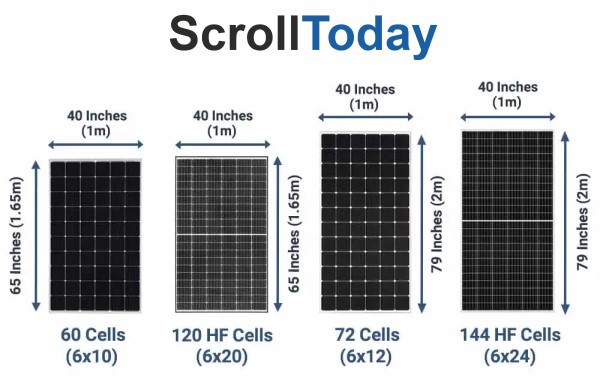
| 60-cell residential | 1.65m – 1.7m | 0.99m – 1.0m | 35mm – 40mm | 18kg – 19kg |
| 72-cell residential/commercial | 1.95m – 2.0m | 0.99m – 1.0m | 35mm – 40mm | 22kg – 23kg |
| Half-cut/compact panels | 1.7m – 1.75m | 1.0m – 1.05m | 30mm – 35mm | 19kg – 20kg |
These figures cover the vast majority of installations across the country, giving you a solid baseline before requesting quotes.
The Role of Cell Configuration
Panel length often correlates directly with the number of cells inside. A 60-cell panel is typically shorter than a 72-cell version, even though both share roughly the same width. This is worth remembering when comparing solar panel dimensions between different product ranges.
How Roof Type Influences Panel Layout
Not all roofs accommodate panels the same way, and solar panel dimensions interact differently depending on pitch, orientation, and obstruction count.
Pitched Roofs
Most UK homes have pitched roofs, which generally offer the most straightforward installation. Panels are mounted parallel to the roof surface using rail systems, and standard solar panel dimensions fit neatly into most rafter spacings.
Flat Roofs
Flat roof installations require angled mounting frames, which changes the spacing needed between rows to avoid shading. This often means fewer panels fit compared to a pitched roof of the same total area, even with identical dimensions of solar panels used.
Roofs With Multiple Obstructions
Older properties with chimneys, dormers, or roof windows lose usable space quickly. A roof that looks large from ground level may only support six or seven panels once obstructions are mapped out.
Solar Panel Dimensions UK Homeowners Should Expect on Typical Properties
Property type has a major influence on how many panels realistically fit. Below is a rough guide based on common UK housing stock.
- Terraced house: 6-8 panels on average, limited by narrower roof spans
- Semi-detached house: 8-12 panels, depending on chimney placement
- Detached house: 12-18 panels, offering the most layout flexibility
- Bungalow: 8-14 panels, varying significantly by roof shape
These numbers assume standard solar panel dimensions and don’t account for shading from trees or neighbouring buildings, which a proper site survey will always reveal.
Efficiency vs Size: Clearing Up a Common Misunderstanding
A frequent assumption is that bigger panels always produce more electricity. In truth, efficiency technology has advanced enough that panel output depends heavily on cell quality, not just physical footprint.
- Monocrystalline cells deliver higher efficiency, often producing strong wattage within compact dimensions.
- Polycrystalline cells are slightly less efficient, sometimes requiring a larger surface area for comparable output.
- PERC and half-cut technology squeezes more power from the same physical size, improving performance without changing dimensions.
This means two panels with nearly identical dimensions can still produce noticeably different energy yields, so always check the wattage rating alongside the measurements.
Working Out How Many Panels Your Roof Can Realistically Hold
A simple estimation method can help before you even contact an installer.
- Measure the usable roof area in metres, avoiding chimneys and vents
- Subtract roughly 0.5m from each edge for safety clearance
- Divide the remaining space by typical panel dimensions, around 1.7m x 1m
- Apply a 10-15% reduction for spacing and mounting hardware
This gives a workable estimate, though a professional survey remains the only way to confirm exact numbers for your property.
Comparing Panel Dimensions Across Leading Brands
Manufacturers vary slightly in sizing, which can influence how many panels fit into a given space.
| Brand | Series | Dimensions (L x W) | Typical Output |
|---|---|---|---|
| LG | NeON series | 1.7m x 1.0m | 350W – 405W |
| JA Solar | Percium series | 1.72m x 1.13m | 400W – 415W |
| REC | Alpha Pure series | 1.72m x 1.02m | 380W – 410W |
| Panasonic | EverVolt series | 1.87m x 1.0m | 400W – 410W |
Even a few centimetres of difference can determine whether an extra row of panels fits along a roof edge, so comparing exact dimensions matters when finalising a quote.
Commercial Installations and Larger Panel Formats
Commercial and industrial buildings often use larger panel formats than domestic properties, sometimes exceeding 2.3 metres in length. Warehouses and factory roofs can accommodate these bigger panels since specialist lifting equipment removes the handling limitations faced during residential installs.
Residential solar panel dimensions stay smaller partly for practicality, allowing two installers to manoeuvre panels safely without cranes or hoists.
Frequently Asked Questions
What size are most residential solar panels in the UK? Most homes use panels measuring roughly 1.7m by 1m, though 72-cell versions can extend closer to 2 metres in length.
Does panel size affect how many I need for my home? Yes, larger panels may mean fewer units are needed to reach your target output, but this depends on roof shape and available space.
Can dimensions vary significantly between manufacturers? Slightly, yes. While most panels sit within a similar range, differences of a few centimetres can affect final layout planning.
How do I find out if my roof suits standard-sized panels? A professional installer will conduct a site survey, though rough estimates can be made using typical panel measurements and your roof’s usable area.
Are commercial solar panels a different size to residential ones? Often, yes. Commercial panels tend to be larger since handling equipment on industrial sites removes the size restrictions faced on domestic roofs.
Final Thoughts
Understanding solar panel dimensions before requesting quotes puts you in a stronger position to make informed decisions about your installation. From roof type to brand variations, small measurement differences can significantly affect how many panels fit and how much energy your system ultimately produces.
Take time to measure your roof’s usable space and compare specifications across a few manufacturers before committing. When you’re ready, book a professional site survey to turn these estimates into an accurate, tailored plan for your home.
