

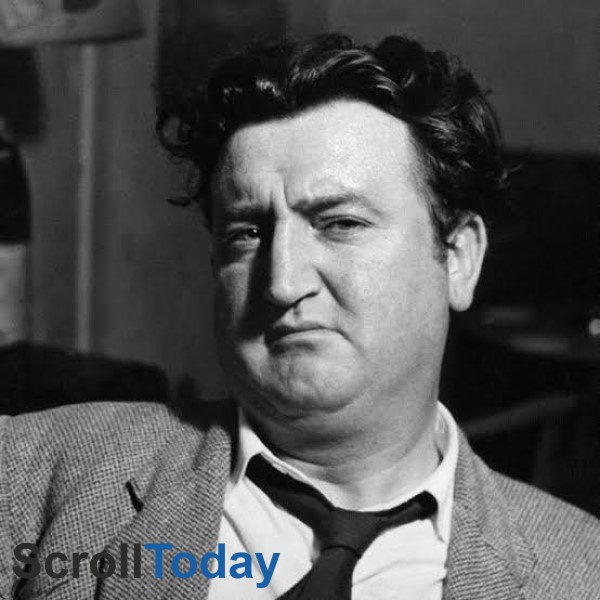
Brendan Behan remains one of the most vivid characters Irish literature has ever produced, a man whose reputation for hard drinking and quick wit sometimes overshadows just how good a writer he actually was. Born in Dublin in 1923, Brendan Behan packed a prison sentence, an IRA past, three acclaimed plays and a string of memorable memoirs into a life that ended far too soon, at just 41. This article traces his story properly, separating the myth from the man while giving his actual work the attention it deserves.
Early Life: How Dublin Shaped Brendan Behan
Brendan Behan was born on 9 February 1923 into a working-class Dublin family steeped in republican and left-wing politics. His father, Stephen, worked as a house painter and was active in labour causes, while his mother, Kathleen, filled the household with songs, stories and a strong sense of Irish identity. That environment gave young Behan both his politics and his ear for language before he’d written a single line professionally.
He left school in 1937 and, like his father, trained as a house painter. But politics pulled harder than paintbrushes. By sixteen, Brendan Behan had joined the IRA, and that decision defined the next chapter of his life far more than any classroom ever could.
Prison Years
In 1939, Behan was sent to England on an IRA bombing mission, was caught, and served time in a borstal, the youth detention experience that later became the basis for his most celebrated book. After returning to Ireland in 1942, he was arrested again, this time for firing at police officers, and received a fourteen-year sentence. He was eventually released in 1946 under a general amnesty.
Those years behind bars weren’t wasted time. Brendan Behan read voraciously, absorbed the rhythms of prison speech, and began shaping the raw material that would later fuel his writing. Few authors have turned incarceration into literary capital quite so effectively.
Brendan Behan Plays: The Works That Made His Name
Brendan Behan plays are where his reputation as a serious writer really took hold, and two in particular still get produced regularly today.
- The Quare Fellow (1954) — A tragicomedy set inside a prison on the night before an execution. It became Behan’s breakthrough, running successfully in Dublin before transferring to London and New York.
- An Giall / The Hostage (1958) — Originally written in Irish as An Giall, then translated and reworked in English as The Hostage. Directed by Joan Littlewood in London, it’s widely considered his masterwork, blending ballads, slapstick and dark satire around the story of a British soldier held hostage by the IRA.
- Richard’s Cork Leg — Left unfinished at his death, this play was later completed by his former director Alan Simpson and staged posthumously in Dublin in 1972.
What makes Brendan Behan plays distinctive is the way tragedy and comedy sit side by side without ever cancelling each other out. Death haunts nearly every one of his stage works, yet the dialogue crackles with jokes, songs and irreverence, a combination that critics have compared to Sean O’Casey and John Millington Synge before him.
Brendan Behan Books: Beyond the Stage
While the plays built his reputation, Brendan Behan books reveal a wider range than most casual readers expect.
Borstal Boy (1958)
This autobiographical account of his time in an English youth detention centre became an instant bestseller and remains his best-known prose work. It’s raw, funny and unexpectedly tender in places, proof that Behan could write about hardship without descending into self-pity.
Later Dictated Works
By the early 1960s, alcoholism had made it nearly impossible for Behan to sit and write in the traditional sense. His editor, Rae Jeffs, began recording him instead, and his last three books were essentially transcribed from tape:
- Brendan Behan’s Island (1962)
- Brendan Behan’s New York (1964)
- Confessions of an Irish Rebel (1965, published posthumously)
He also wrote The Scarperer (1964), a smuggling novel first serialised in the Irish Press, and After the Wake, a collection of short fiction. None of these later works match the polish of Borstal Boy, but they carry his voice intact funny, digressive and unmistakably Dublin.
| Work | Type | Year | Notable For |
|---|---|---|---|
| The Quare Fellow | Play | 1954 | Breakthrough success, prison setting |
| Borstal Boy | Autobiography | 1958 | Bestseller, based on his borstal years |
| The Hostage | Play | 1958 | Considered his masterwork |
| Brendan Behan’s Island | Memoir | 1962 | Dictated on tape |
| Confessions of an Irish Rebel | Memoir | 1965 | Published after his death |
Brendan Behan Quotes: Wit as Sharp as His Writing
Brendan Behan quotes have taken on a life of their own, circulating in pub conversations and literary anthologies alike, often outliving the context they came from. He once described his own hobbies as drinking, talking and swimming, a line that sums up his self-aware humour better than any biography could. His reputation for quick, cutting remarks made him a favourite guest on television and radio, even as his drinking made those appearances increasingly unpredictable.
Many Brendan Behan quotes touch on Ireland, class and the absurdity of respectability, reflecting a mind that never took authority. political, religious or literary, entirely seriously. That refusal to be solemn, even about serious subjects, is arguably his most lasting stylistic signature.
Personal Life and Struggles
Brendan Behan married the artist Beatrice ffrench-Salkeld in 1955, and the couple had one daughter, Blanaid, born shortly before his death. Beatrice later wrote about their life together, offering a more intimate picture of a man whose public persona often obscured his private struggles.
Behan battled alcoholism from a remarkably young age by some accounts starting as early as eight years old and it defined the final years of his life. Diabetic comas and alcohol-related seizures repeatedly put him in hospital during the early 1960s. He died in Dublin on 20 March 1964, aged 41, from complications linked to diabetes and years of heavy drinking.
Frequently Asked Questions
What is Brendan Behan best known for? Brendan Behan is best known for his plays The Quare Fellow and The Hostage, along with his autobiography Borstal Boy.
Was Brendan Behan a member of the IRA? Yes, Behan joined the IRA at sixteen and served prison sentences connected to his activities, experiences that heavily influenced his writing.
How did Brendan Behan die? Brendan Behan died on 20 March 1964 in Dublin, from complications of diabetes worsened by long-term alcoholism.
Did Brendan Behan write in Irish as well as English? Yes. His play An Giall was written in Irish before he translated and adapted it into English as The Hostage.
Who were Brendan Behan’s siblings? His brothers Dominic Behan and Brian Behan were also writers, with Dominic best known for songs like “The Patriot Game.”
Conclusion
Brendan Behan’s story is one of genuine talent colliding with genuine chaos, a writer who turned prison cells, republican politics and a punishing drinking habit into some of the most distinctive Irish literature of the twentieth century. From the stagecraft of Brendan Behan plays to the raw honesty of his memoirs, his work still rewards readers who look past the barroom legend. If you haven’t read him yet, start with Borstal Boy or catch a production of The Hostage, either one will show you exactly why Brendan Behan’s name still carries weight more than sixty years after his death.
